John Elway’s Last Stand: Remembering Super Bowl XXXIII

When the Denver Broncos clash with the Atlanta Falcons at Mercedes-Benz Stadium for their preseason opener on Friday, the game will provide fans with an early look at the 2026 roster. While the result won’t count in the standings, the matchup provides a chance to look back on one of the most memorable nights in franchise history.
On January 31, 1999, the Broncos defeated the Falcons 34-19 in Super Bowl XXXIII, capturing their second consecutive Lombardi Trophy and bringing the John Elway era to a storybook conclusion. Although Denver would later add another championship in Super Bowl 50, its victory over Atlanta remains one of the defining moments in franchise history.
For many fans, the final score is easy to remember. What is often forgotten are the storylines that surrounded the game. From Elway’s pursuit of the perfect ending to Dan Reeves facing the franchise he once coached, Super Bowl XXXIII was about far more than crowning another champion.
John Elway’s Storybook Ending
One year earlier, John Elway had finally silenced years of criticism by leading the Broncos to their first Super Bowl championship. After three previous Super Bowl losses, the Hall of Fame quarterback was no longer viewed as a great signal-caller who could never win the big one.
For much of his career, Elway’s legacy had been defined by the Super Bowl losses that came before Denver finally broke through. Elway and the Broncos reached Super Bowl XXI, only for Denver to lose to the New York Giants. A year later, Elway and the Broncos made it to Super Bowl XXII, but Denver was overwhelmed by the Washington Redskins. Elway then guided the Broncos to Super Bowl XXIV, but Denver suffered another lopsided defeat – this time at the hands of the San Francisco 49ers.
Those losses became part of the Elway narrative. Despite his individual accomplishments, including the 1987 NFL MVP Award, multiple Pro Bowl selections, and a reputation as one of the most talented quarterbacks of his generation, Elway was often judged by what he had failed to accomplish in the postseason.
That changed in 1997.
Elway finally led the Broncos past the Super Bowl hurdle, defeating Brett Favre and the Green Bay Packers 31-24 in Super Bowl XXXII. The victory gave Denver its first championship and gave Elway the validation that had eluded him for most of his career.
But there was still something missing from Elway’s first championship performance. He completed just 10 of 22 passes for 123 yards with no touchdowns and an interception, while rushing for 17 yards and a touchdown on five carries. Elway made several important plays in Super Bowl XXXII, including his memorable helicopter run, but Terrell Davis was the driving force behind the Broncos’ offense. Davis rushed for 157 yards and three touchdowns and was named Super Bowl MVP.
Denver had finally won the championship that had eluded it, but Elway’s performance wasn’t the dominant quarterback showcase many had envisioned for one of the game’s all-time greats. With retirement approaching, Super Bowl XXXIII represented Elway’s final opportunity to prove he could be the focal point of a Broncos offense that won a championship.
Still, uncertainty surrounded his future entering the 1998 season. At 38 years old and after 16 NFL seasons, retirement seemed increasingly likely. Although Elway never officially declared the campaign would be his last, there was a growing sense throughout the year that he was making one final run at another Lombardi Trophy.
Instead of taking a step backward, Denver put together an even more impressive regular season. The Broncos finished 14-2, earning the AFC’s top seed and establishing themselves as one of the league’s best teams. Denver then navigated the playoffs without losing, defeating the Miami Dolphins in the Divisional Round and the New York Jets in the 1998 AFC Championship Game to earn another trip to the Super Bowl.
The stakes were now about more than defending a championship. The Broncos had a chance to become the first team in the AFC to win back-to-back Super Bowls since the Pittsburgh Steelers of the 1970s, while Elway had an opportunity to end his career with consecutive championships.
For a quarterback who had spent much of his career being defined by the Super Bowl games he couldn’t win, the possibility of leaving the NFL after winning two straight was almost too perfect to imagine.
And on January 31, 1999, Elway had one final game to make it happen.
Dan Reeves Returns to Face Denver
While John Elway’s future dominated headlines, the opposing sideline featured a compelling story of its own.
Falcons head coach Dan Reeves spent 12 seasons leading the Broncos, guiding the franchise to three Super Bowl appearances and helping shape Elway’s early career. But by the early 1990s, Reeves’ relationship with Denver’s front office and his star quarterback had deteriorated.
Part of the conflict centered around how the Broncos should be run. Reeves had considerable authority within the organization. In addition to serving as head coach, he was the team’s offensive coordinator and vice president, giving him control over virtually all player personnel decisions. Reeves preferred to maintain that level of authority, while owner Pat Bowlen wanted responsibilities to be distributed more evenly throughout the organization.
Elway eventually became part of the dispute as well. The quarterback publicly expressed his belief that Reeves should relinquish some control of the offense, adding another layer of tension to an already strained relationship.
Reeves was ultimately dismissed following the 1992 season. His successor was Mike Shanahan, who had previously worked under Reeves in Denver before the two coaches experienced their own bitter falling-out.
Their relationship had deteriorated to the point that Shanahan and Reeves were hardly on speaking terms by the time they met in Super Bowl XXXIII. Before the game, Shanahan called Reeves a liar and said the two could never be friends again. Reeves, meanwhile, questioned whether Shanahan had his best interests in mind during their time together with the Broncos.
The roots of that animosity went back to Shanahan’s dismissal in 1992. On the day Reeves fired him, Shanahan said Reeves told him he was being let go because Reeves wanted to take over the team’s offensive play-calling. Later that week, The Denver Post reported that Reeves had fired Shanahan for insubordination – a reason Shanahan said he did not learn until he read it in the newspaper.
That history added another layer to an already fascinating Super Bowl matchup. Reeves was attempting to win his first championship against the franchise that had moved on from him, while Shanahan was coaching against the man who had fired him. And standing on the other sideline was the quarterback with whom Reeves had shared some of the most successful – and contentious – years in Broncos history.
Reeves had also engineered one of the league’s biggest surprises. After finishing 7-9 the previous season, Atlanta posted a 14-2 record and reached its first Super Bowl in franchise history, transforming the Falcons into one of the NFL’s biggest success stories almost overnight.
An Unexpected Distraction
As if the game didn’t already have enough intrigue, Atlanta faced an enormous distraction less than 24 hours before kickoff.
Falcons safety Eugene Robinson was one of the key players on Atlanta’s surprise 1998 team. A veteran who was selected to the Pro Bowl that season, Robinson played an important role in helping the Falcons reach their first Super Bowl in franchise history.
His importance to Atlanta’s postseason run was particularly evident in the 1998 NFC Championship Game against the Minnesota Vikings. With the game tied 27-27 in overtime, Vikings quarterback Randall Cunningham launched a deep pass toward star receiver Randy Moss. Robinson narrowly broke up the pass, preventing what could have been a game-winning touchdown. Minnesota was forced to punt, and the Falcons subsequently drove to the Vikings’ 21-yard line, where Morten Andersen converted a 38-yard field goal to give Atlanta a 30-27 victory and its first Super Bowl appearance.
The day before Super Bowl Sunday, Robinson received the Athletes in Action/Bart Starr Award, an honor presented annually to the NFL player who best exemplifies outstanding character and leadership at home, on the field and in the community.
That night, Robinson was arrested by an undercover police officer for soliciting a prostitute.
The incident immediately became a national story and created an uncomfortable contrast with the honor Robinson had received only hours earlier. Robinson agreed to return the award following his arrest, but the controversy followed him into the Super Bowl.
Robinson reportedly got very little sleep that night, leaving one of the Falcons’ most important defensive players to prepare for the biggest game in franchise history while dealing with the fallout from an embarrassing and highly publicized arrest.
Atlanta ultimately fell 34-19, and Robinson faced widespread criticism from both the media and fans for his actions the previous night. He remained with the Falcons for one more season before leaving the organization.
The incident became one of the strangest footnotes in Super Bowl history: a Pro Bowl player who had just made one of the defining plays of Atlanta’s postseason run, and who had received an award recognizing his character and leadership earlier that day, was arrested that night and had to play the biggest game of his career less than 24 hours later.
Denver Finishes the Job
Although the Broncos entered Super Bowl XXXIII as the defending champions, they still had to earn their place in history.
The two teams traded early scores before Denver seized control late in the second quarter. On first-and-10 from the Broncos’ own 20-yard line, John Elway connected with Rod Smith over the middle. Smith broke free from the Falcons’ secondary and sprinted 80 yards for a touchdown, giving Denver a 17-3 lead.
Atlanta answered with a field goal before halftime, but the Broncos entered the locker room comfortably ahead 17-6.
Denver’s offense continued to wear down the Falcons’ defense after halftime. Meanwhile, the Broncos’ defense frustrated Atlanta’s offense throughout the contest, intercepting three passes from Falcons quarterback Chris Chandler and sacking him twice.
Early in the fourth quarter, Elway tossed a 39-yard pass to Terrell Davis, moving the ball all the way to Atlanta’s 9-yard line. Two plays later, Elway capped the drive with a rushing touchdown to give Denver a commanding 31-6 lead, effectively putting the game out of reach.
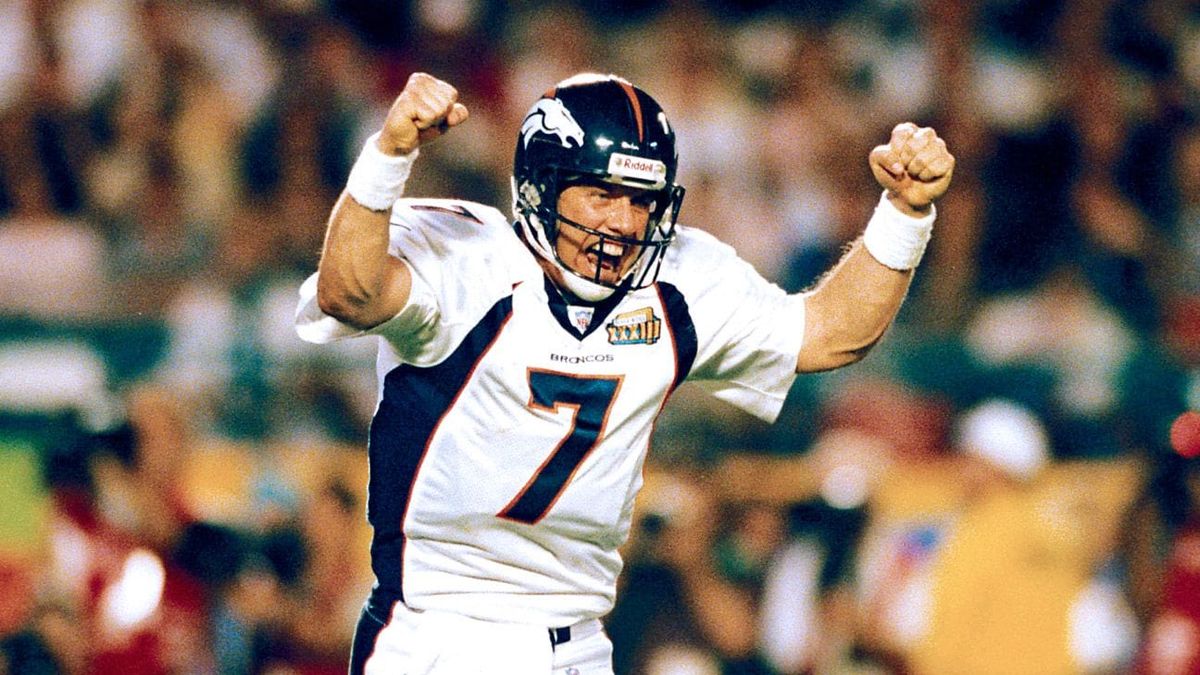
When the final whistle sounded, the Broncos had secured a 34-19 victory, their second consecutive Super Bowl championship, and the perfect ending to one of the greatest careers in NFL history.
A Fitting Conclusion to a Legendary Era
Super Bowl XXXIII represented much more than another championship for Denver.
It marked the end of John Elway’s remarkable playing career, validated the Broncos’ first title by proving it was no one-year wonder, and cemented Mike Shanahan’s place among the NFL’s elite coaches. Elway’s performance made the ending even more fitting, as he was named Super Bowl XXXIII MVP after throwing for 336 yards and a touchdown while adding a rushing score.
Together, Elway, Shanahan, Terrell Davis, Rod Smith, Steve Atwater, and the rest of Denver’s veteran core closed one of the greatest chapters in franchise history in unforgettable fashion.
The Broncos and Falcons have met several times since that duel in Miami, but no meeting between the two franchises has carried the same significance. As Denver heads to Atlanta for its preseason opener, it’s the perfect opportunity to remember the night the Broncos completed their back-to-back championship run and John Elway rode off into the sunset exactly the way every athlete dreams of doing – as a Super Bowl champion and Super Bowl MVP.