Ranking the Five Biggest Trades in Broncos History

The MLB trade deadline always serves as a reminder of how quickly one transaction can reshape a franchise. This year was no exception, as the Los Angeles Dodgers acquired two-time American League Cy Young Award winner Tarik Skubal from the Detroit Tigers, while the Boston Red Sox landed three-time All-Star catcher Adley Rutschman from the Baltimore Orioles. While blockbuster trades are far less common in the NFL, they often carry even greater consequences when they do occur.
The Denver Broncos have been involved in several trades that forever altered the direction of the franchise. Some brought Hall of Fame talent to Denver, others marked the beginning of a new era, and one delivered the greatest player in team history. Here is a look at the five biggest trades in Broncos history:
5. Trading for Gary Zimmerman (1993)
Denver entered the 1993 offseason looking to maximize John Elway’s championship window, and upgrading the offensive line quickly became a priority. The Broncos accomplished exactly that by acquiring Hall of Fame left tackle Gary Zimmerman from the Minnesota Vikings in exchange for first-, second-, and sixth-round draft picks spread across three drafts. It was a significant investment, but one that paid dividends almost immediately.
Zimmerman became one of the NFL’s premier offensive linemen during his five seasons in Denver. He earned one First-Team All-Pro nod, two Second-Team All-Pro selections, and three Pro Bowl berths while anchoring one of football’s most productive offenses. With Zimmerman protecting Elway, the Broncos led the AFC in total offense in 1995 before leading the entire NFL in total offense during both the 1996 and 1997 seasons, while also pacing the league in rushing in 1996.
Zimmerman’s final game proved to be the perfect ending to a remarkable career. He helped pave the way for Denver’s victory in Super Bowl XXXII before retiring as a champion. Although offensive linemen rarely receive the same recognition as quarterbacks or skill players, few trades had a greater impact on the Broncos’ first championship than this one.
4. Trading Jay Cutler (2009)
Few trades in franchise history generated as much controversy as Denver’s decision to trade Jay Cutler following the 2008 season. Cutler was coming off a Pro Bowl campaign in which he threw for 4,526 yards, but tensions rose after the Broncos fired longtime head coach Mike Shanahan and unsuccessfully attempted to acquire Matt Cassel. Feeling unwanted by the organization, Cutler requested a trade, bringing a swift end to his time in Denver.
The Broncos ultimately sent Cutler and a fifth-round pick to the Chicago Bears in exchange for quarterback Kyle Orton, first-round picks in 2009 and 2010, and a 2009 third-round selection. On paper, the return appeared substantial and gave Denver valuable assets to accelerate its rebuilding process. The trade also provided the Broncos with additional flexibility as the organization began a new era under Josh McDaniels.
The return ultimately proved to be a mixed bag. Denver missed on Robert Ayers after selecting him ahead of future All-Pro linebacker Clay Matthews in 2009, but the draft capital acquired from Chicago also helped the Broncos acquire Demaryius Thomas, Eric Decker, and Tim Tebow the following year. While Thomas developed into one of the greatest wide receivers in franchise history and Decker became a reliable starter, the trade remains one of the most debated in team history because of the circumstances surrounding Cutler’s departure.
3. Trading for Russell Wilson (2022)
No trade in recent franchise history generated more excitement than Denver’s acquisition of Russell Wilson. The Broncos surrendered multiple premium draft picks along with Drew Lock, Noah Fant, and Shelby Harris to acquire the perennial Pro Bowl quarterback, believing they had finally solved their long-running search for Peyton Manning’s successor. Expectations immediately shifted from playoff contender to Super Bowl hopeful.
Instead, the trade quickly unraveled. Wilson finished just 11-19 as Denver’s starting quarterback, and the Broncos failed to score more than 20 points in 16 of his 30 starts while being held to 10 points or fewer five times. By the end of the 2023 season, the relationship between Wilson and the organization had deteriorated to the point that Denver benched him for the final two games to avoid triggering a $37 million injury guarantee in his contract.
The Broncos officially released Wilson in March of 2024, absorbing an NFL-record $85 million dead-cap charge in the process. Despite its disappointing outcome, the trade remains one of the biggest in team history because of its enormous expectations and unprecedented fallout. Few moves have changed the trajectory of the organization more dramatically, even if it was for all the wrong reasons.
2. Trading Clinton Portis for Champ Bailey (2004)
Denver made a bold decision in 2004 by trading one of the league’s most dynamic young running backs in Clinton Portis for cornerback Champ Bailey. Portis had rushed for more than 1,500 yards in each of his first two NFL seasons, making the move one of the most surprising player-for-player trades of its era. The Broncos believed an elite shutdown corner would have a greater long-term impact, and that gamble paid off.
Bailey quickly became the cornerstone of Denver’s defense during his decade with the Broncos. He earned eight Pro Bowl selections with Denver, tied with Steve Atwater and Von Miller for the most by a defensive player in franchise history. Bailey also led the NFL with 10 interceptions in 2006 and finished his Broncos career with 34 interceptions, the fourth-most in franchise history.
Bailey’s impact extended well beyond the stat sheet. His memorable 100-yard interception return against Tom Brady in Denver’s 27-13 victory over the New England Patriots in the 2005 Divisional Round remains one of the most iconic defensive plays in franchise history. While Portis enjoyed a successful career after leaving the Broncos, Bailey became a Hall of Famer and one of the greatest players ever to wear orange and blue.
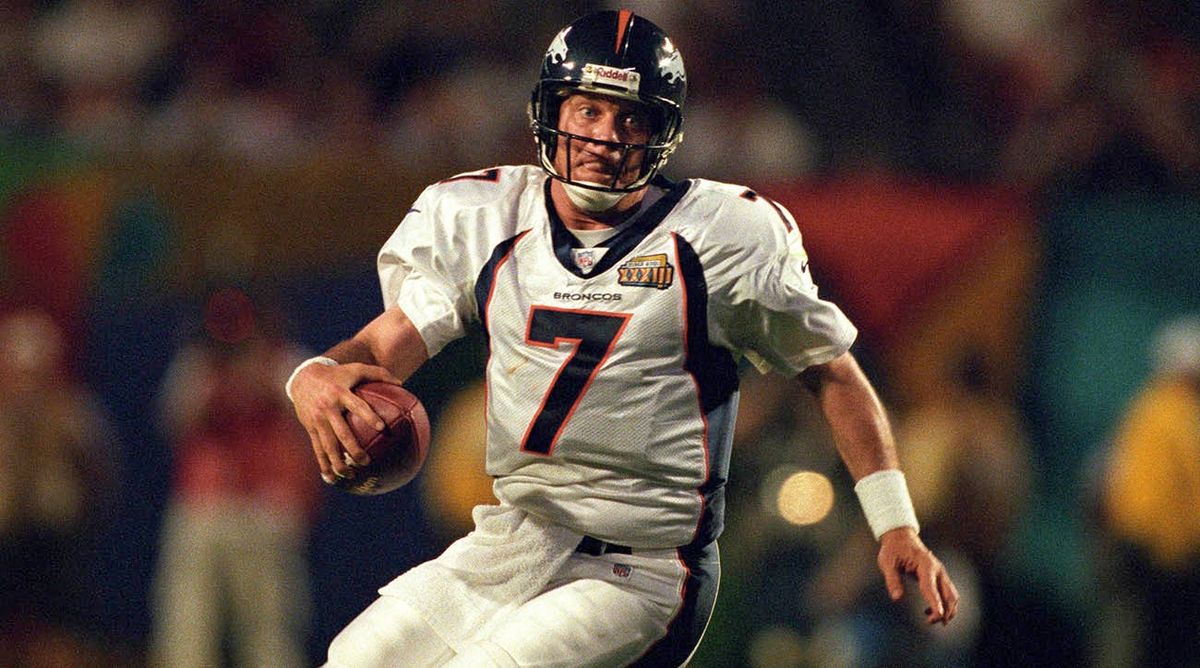
1. Trading for John Elway (1983)
No trade has had a greater impact on Denver than the acquisition of John Elway. After the Baltimore Colts selected Elway with the No. 1 overall pick in the 1983 NFL Draft, he made it clear he had no intention of playing for the organization. The Broncos capitalized by acquiring his rights in one of the most consequential trades in NFL history.
Elway immediately transformed Denver into perennial contenders. He led the Broncos to five Super Bowl appearances, won back-to-back championships, earned nine Pro Bowl selections – the most in franchise history – and was named Super Bowl XXXIII MVP in the final game of his legendary career. By the time he retired, Elway had become the face of the franchise and one of the greatest quarterbacks the game has ever seen.
His impact on Denver remains unmatched more than four decades later. Elway still holds the franchise records for passing yards (51,475) and passing touchdowns (300), accomplishments that reflect both his longevity and excellence. The Broncos’ history would look dramatically different if Denver had not made that trade.