The Broncos Finally Break Through: Remembering Super Bowl XXXII

When the Denver Broncos host the Green Bay Packers for a preseason duel on Friday night, the game will offer fans another opportunity to see the 2026 roster in action. While the result won’t count in the standings, the matchup also provides a chance to revisit one of the most important games in franchise history.
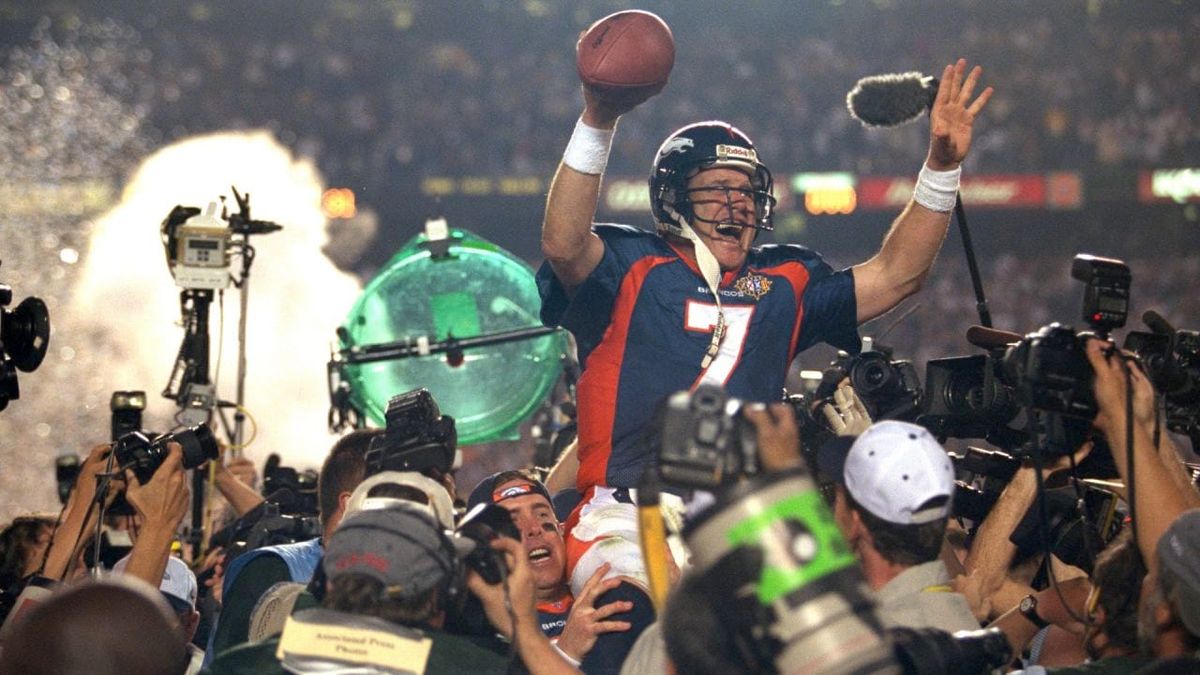
On January 25, 1998, Denver defeated Green Bay 31-24 in Super Bowl XXXII, capturing its first championship in franchise history. The victory finally erased years of postseason heartbreak for John Elway and ended the AFC’s 13-year Super Bowl drought.
For many Broncos fans, the final score is unforgettable. But the significance of that night went far beyond Denver finally winning the Lombardi Trophy. Elway was trying to overcome the ghosts of three previous Super Bowl losses, Mike Shanahan was looking to complete his own journey back to the top of the NFL, Terrell Davis was emerging as one of the league’s most dominant running backs, and the defending champion Packers stood in the Broncos’ way.
John Elway’s Long Road to a Championship
For much of his career, John Elway’s legacy had been defined by the Super Bowl losses that came before Denver finally broke through. Elway and the Broncos reached Super Bowl XXI, only for Denver to lose by 19 points to the New York Giants. A year later, Elway and the Broncos made it to Super Bowl XXII, but Denver was blown out by the Washington Redskins. Elway then guided the Broncos to Super Bowl XXIV, but Denver suffered another lopsided defeat – this time at the hands of the San Francisco 49ers.
Those losses became part of the Elway narrative. Despite his individual accomplishments, including the 1987 NFL MVP Award, multiple Pro Bowl selections, and a reputation as one of the most talented quarterbacks of his generation, Elway was often judged by what he had failed to accomplish on the biggest stage.
Entering the 1997 season, Elway was 37 years old and had already spent 14 seasons in the NFL. Time was becoming a factor, and another Super Bowl opportunity was no longer something anyone could take for granted.
But the Broncos put together a remarkable season.
Denver finished the regular season 12-4 before defeating the Jacksonville Jaguars in the Wild Card Round, the Kansas City Chiefs in the Divisional Round and the Pittsburgh Steelers in the 1997 AFC Championship Game. The Broncos’ 24-21 victory over Pittsburgh sent them to their fifth Super Bowl and gave Elway another opportunity to accomplish what had eluded him throughout his career.
Standing in his way of football immortality was Green Bay, the defending Super Bowl champion.
Denver’s Chance to End the AFC’s Drought
The Broncos’ struggles in the Super Bowl weren’t happening in a vacuum.
Denver was 0-4 in its first four Super Bowl appearances, with three of those defeats coming during the John Elway era. None of those games were particularly close.
The AFC had spent more than a decade watching the NFC dominate the league’s championship game. The NFC had won 13 consecutive Super Bowls entering the 1997 season, with the last AFC team to win being the Los Angeles Raiders in Super Bowl XVIII.
The Broncos had experienced that dominance firsthand.
By the time Denver reached Super Bowl XXXII, the Broncos had become almost synonymous with the AFC’s inability to defeat the NFC on the big stage.
Denver had a chance to finally change the narrative surrounding its own franchise while simultaneously ending one of the longest periods of conference dominance in NFL history.
The Packers, however, weren’t exactly an easy opponent to choose for such a mission.
Brett Favre and the Defending Champions
Green Bay entered Super Bowl XXXII as the defending NFL champion.
Led by quarterback Brett Favre, the Packers defeated the New England Patriots 35-21 in Super Bowl XXXI and entered the 1997 season as one of the league’s premier teams. Favre won the NFL MVP Award three consecutive times from 1995 to 1997, becoming the first player in NFL history to win the honor three straight times shortly before Super Bowl XXXII.
Green Bay finished the regular season 13-3, earning the NFC’s top seed. The Packers then defeated the Tampa Bay Buccaneers in the Divisional Round and San Francisco in the 1997 NFC Championship to return to the Super Bowl.
Green Bay was heavily favored to repeat.
The Broncos, meanwhile, were trying to prove that they belonged on the same stage.
That created a compelling contrast. Favre represented the new generation of NFL quarterbacks and was already a Super Bowl champion. Elway represented the veteran who had spent his career chasing the championship that Favre had already captured.
Denver wasn’t simply facing the defending champions.
The Broncos were trying to take their place.
Mike Shanahan’s Redemption
Elway wasn’t the only one on Denver’s side carrying unfinished business into Super Bowl XXXII.
Mike Shanahan had already experienced the highs and lows of NFL coaching before returning to the Broncos. He initially joined Denver’s staff under Dan Reeves and served as the Broncos’ offensive coordinator before being fired following the 1991 season.
Shanahan eventually joined the 49ers, where he won Super Bowl XXIX as the team’s offensive coordinator.
When he returned to Denver as head coach in 1995, he inherited an aging Elway and a franchise that had experienced plenty of postseason disappointment.
The first few years weren’t easy.
The Broncos went 8-8 in Shanahan’s first season as head coach and then entered the 1996 campaign with enormous expectations. Denver finished 13-3 and appeared poised to reach the 1996 AFC Championship Game, only to suffer a stunning 30-27 Divisional Round loss to the Jacksonville Jaguars.
That defeat became fuel for the following season.
The Broncos rebuilt around Elway, Terrell Davis and a talented veteran core, and Denver responded with another 12-4 season. This time, the Broncos finished the job in the playoffs.
Shanahan had another chance to prove that he could build a championship team.
But he would need his offense to overcome one of the best defenses in football.
Terrell Davis Takes Center Stage
John Elway was still the face of the franchise, but Terrell Davis had become the engine powering Denver’s offense.
Davis rushed for 1,750 yards during the 1997 regular season, establishing himself as one of the NFL’s premier running backs. He followed that performance with 184 rushing yards and two touchdowns against Jacksonville in the Wild Card Round, 101 rushing yards and two touchdowns against the Kansas City Chiefs in the Divisional Round, and 139 rushing yards and a touchdown against the Pittsburgh Steelers in the 1997 AFC Championship Game.
By the time the Broncos arrived in San Diego, Davis had become impossible to overlook.
Denver was no longer simply an Elway-led team relying on its quarterback to carry the entire offense. The Broncos had developed a physical running game that allowed them to control the clock, wear down opposing defenses and take pressure off their aging quarterback.
That made Davis’ availability for Super Bowl XXXII particularly important.
Davis had dealt with migraines since childhood and typically took medication before games to help prevent them. On this particular day, however, he forgot to take his medication. Everything was fine until the first quarter, when he took a knee to the top of his helmet. The impact triggered a migraine, and Davis’ vision became so impaired that he could barely see.
Davis told Mike Shanahan what he was experiencing, but Shanahan still wanted him on the field as a decoy. Davis remained in the game for another play, helping sell a fake that allowed Elway to keep the ball and score a rushing touchdown. He then went to the locker room for treatment before returning in the second half.
Despite battling a migraine that had temporarily taken away his vision, Davis resumed his role as the centerpiece of Denver’s offense.
The Packers had a three-time NFL MVP at quarterback and a defense filled with stars, including Reggie White, LeRoy Butler, and Gilbert Brown.
The Broncos’ answer was simple: run the football.
And Davis delivered one of the greatest performances in Super Bowl history.
Denver Finally Finishes the Job
Green Bay struck first in Super Bowl XXXII.
Brett Favre connected with Antonio Freeman for a 22-yard touchdown on the game’s opening possession to give the Packers a 7-0 lead, but Denver quickly responded. Elway helped orchestrate a scoring drive on the game’s ensuing possession that ended with Davis punching in a one-yard touchdown to make it a 7-7 contest.
The Broncos continued to lean on their running game, and Davis repeatedly found ways to break through Green Bay’s defense.
Denver entered halftime with a 17-14 lead, and the game remained a back-and-forth battle throughout the second half.
One of the game’s most memorable moments came in the third quarter.
With the Broncos facing third-and-6 from the Packers’ 12-yard line, Elway scrambled for a crucial first down and went airborne, absorbing several hits as he dove for a fresh set of downs. The play became known as the “Helicopter,” thanks to the way Elway’s body spun through the air as he took contact.
It perfectly captured the tone of Denver’s performance.
The Broncos weren’t backing down.
Neither was Elway.
Two plays after Elway’s gutsy scramble, Davis punched in his second touchdown of the contest and Denver took a 24-17 lead.
Green Bay tied the game 24-24 early in the fourth quarter, but the Broncos answered once again. With less than two minutes left in regulation, Davis rushed for 17 yards to put Denver at the Packers’ 1-yard line. He punched in his third touchdown of the contest on the next play to give the Broncos a 31-24 lead.
Green Bay still had one final opportunity.
The Packers drove into Denver territory, but the Broncos’ defense held firm. On fourth-and-6 with less than a minute left in regulation, Favre’s pass attempt to tight end Mark Chmura fell incomplete, ending Green Bay’s final possession and sending Denver into a celebration more than 20 years in the making.
The Broncos had finally done it.
Denver had won the Super Bowl.
A New Chapter in Franchise History
Terrell Davis finished the afternoon with 157 rushing yards and three rushing touchdowns, earning Super Bowl XXXII MVP honors. He became the first player in Super Bowl history to score three rushing touchdowns. And he accomplished the feat despite briefly leaving the game while battling a migraine.
But Davis wasn’t the only Bronco who had finally reached the mountaintop.
For John Elway, the victory completed one of the greatest redemption stories in NFL history. After three Super Bowl defeats, he finally had the championship that had eluded him for 14 seasons.
For Mike Shanahan, it validated the decision to return to Denver and build a team capable of competing with the NFL’s elite.
For the Broncos as a franchise, it erased the stigma of being unable to win the big game.
And for the AFC, it finally brought an end to 13 consecutive Super Bowl losses to the NFC.
The victory would also prove to be only the beginning.
One year later, Denver would return to the Super Bowl and defeat the Atlanta Falcons, giving Elway his second championship and allowing him to ride off into retirement as the Super Bowl XXXIII MVP.
But none of that would have been possible without what happened at Qualcomm Stadium on January 25, 1998.
Super Bowl XXXII wasn’t simply the night the Broncos won their first championship.
It was the night Denver finally broke through.