Von Miller’s Legacy Game: Remembering Super Bowl 50

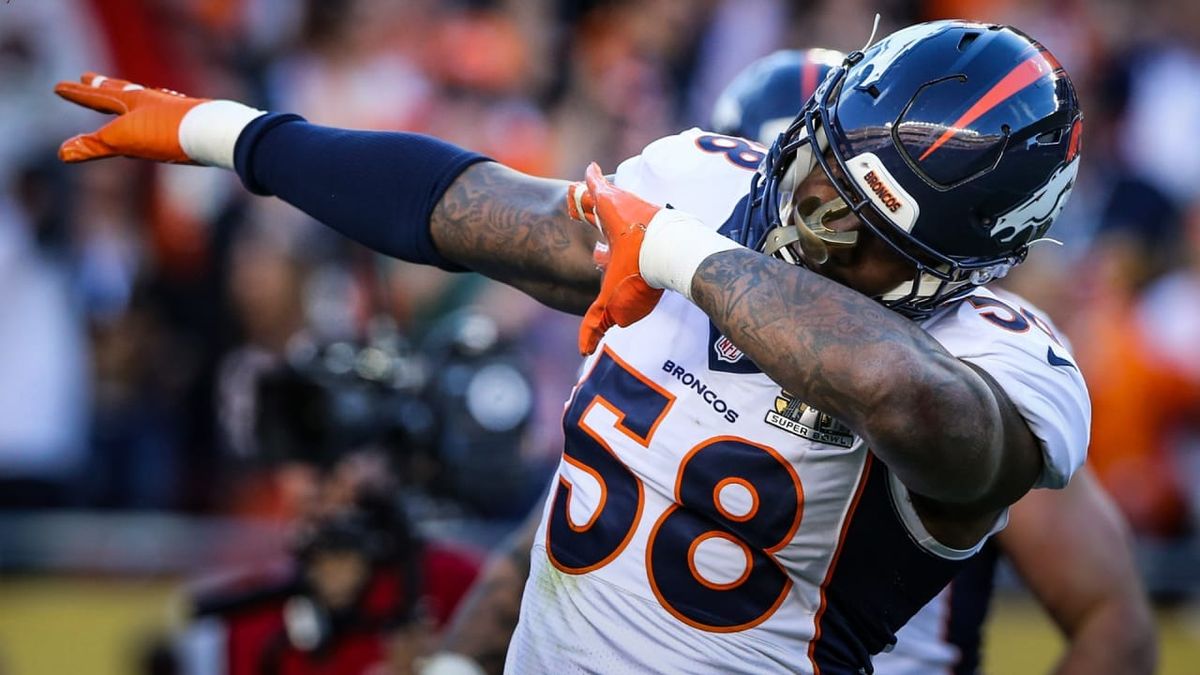
When the Denver Broncos and Carolina Panthers meet in Week 9, they’ll renew a matchup that produced one of the most memorable games in franchise history. Nearly 11 years after Super Bowl 50, the Broncos’ 24-10 victory remains a defining moment for a team that overcame an inconsistent offense with one of the greatest defenses the NFL has seen.
The game also marked Peyton Manning’s final appearance in the NFL, ending his legendary career with a second Super Bowl championship. But while Manning got his storybook finish, it was Von Miller and Denver’s defense that stole the show against a Panthers team that had overwhelmed opponents all season.
Peyton Manning’s Final Run
The Broncos entered the 2015 season with a new head coach in Gary Kubiak and an offense adjusting to a different system. Peyton Manning, then 39, was nearing the end of his career and dealing with injuries that made it increasingly difficult to perform at his usual level.
Manning’s struggles became impossible to ignore midway through the season. After throwing four interceptions against the Kansas City Chiefs in Week 10, he was benched in favor of backup Brock Osweiler. Osweiler took over as the starter while Manning worked his way back from a torn plantar fascia in his left foot.
Manning’s statistical production reflected just how challenging the season had become. He finished the regular season completing less than 60 percent of his passes for 2,249 yards, nine touchdowns and 17 interceptions. It was a far cry from the prolific numbers that had defined much of his career.
Osweiler helped keep Denver afloat during Manning’s absence, leading the Broncos to a 5-2 record in his seven starts. He completed 61.8 percent of his passes for 1,967 yards, 10 touchdowns and six interceptions, giving the Broncos enough stability to remain atop the AFC West race.
Manning eventually returned to action in a Week 17 matchup against the San Diego Chargers, with Denver needing a victory to clinch the AFC West and the AFC’s No. 1 seed. Osweiler started the game, but Manning replaced him in the third quarter and helped spark the offense, leading the Broncos to 20 points over the final quarter and a half. Denver came away with a 27-20 victory, securing the top seed and giving Manning back the starting job heading into the playoffs.
The Broncos finished the regular season 12-4, earning the AFC’s top seed. They then defeated the Pittsburgh Steelers 23-16 in the Divisional Round before edging the defending champion New England Patriots 20-18 in the 2015 AFC Championship Game.
Neither playoff victory came easily. Denver’s offense struggled to consistently generate points, placing even more pressure on its defense to deliver. By the time the Broncos reached Super Bowl 50, they had established a clear formula for winning: protect the football, capitalize on defensive takeaways and do enough offensively to finish the job.
Manning was no longer the unstoppable force who had once terrorized opposing defenses. But he had one more opportunity to finish his career with a championship.
The “No Fly Zone” and a Relentless Pass Rush
Although Peyton Manning’s health and the offense’s inconsistency dominated much of the discussion surrounding Denver, the team’s defense had become its greatest strength.
The 2015 Broncos finished first in the NFL in total defense and scoring defense, allowing just 18.5 points per game. They surrendered only 283.1 yards per game, led the league with 52 sacks and allowed a league-low 199.6 passing yards per contest.
The defense’s success came from a combination of relentless pass-rushing and physical coverage. Von Miller and DeMarcus Ware led the charge up front, giving Denver two elite pass-rushers capable of overwhelming opposing offensive lines. Behind them, cornerbacks Chris Harris Jr. and Aqib Talib helped establish the secondary’s identity as the “No Fly Zone,” with safety T.J. Ward providing another physical presence.
The Broncos’ defensive dominance was evident throughout the postseason. In the Divisional Round, Denver held the Steelers to just one touchdown and recorded three sacks. Pittsburgh converted only two of its 12 third-down attempts, failed on both fourth-down attempts and reached the end zone on just one of three red-zone trips.
The following weekend, the Broncos’ defense delivered another standout performance against the Patriots. Denver recorded four sacks, 17 quarterback hits, 10 pass deflections and two interceptions while holding New England to just two conversions on 15 third-down attempts. The Broncos also intercepted Tom Brady on a potential game-tying two-point conversion attempt late in the fourth quarter.
Miller was particularly disruptive against the Patriots, finishing with five tackles, 2.5 sacks, two tackles for loss, a pass deflection, four quarterback hits and an interception. His performance helped propel Denver to the Super Bowl while reinforcing his status as one of the league’s most dangerous defensive players.
When the Broncos arrived in Santa Clara, they had already established themselves as a defense capable of shutting down even the NFL’s most accomplished offenses. They would need that same level of dominance against a Carolina team that had overwhelmed opponents throughout the season.
The Panthers’ Unstoppable Offense and Ferocious Defense
Carolina entered Super Bowl 50 with a 15-1 regular-season record and one of the most productive offenses in the league. Cam Newton was at the center of it all, winning the AP NFL Most Valuable Player award after accounting for 45 total touchdowns during the regular season.
Newton’s combination of passing ability, speed and physical running made him exceptionally difficult to defend. He finished the season with 35 passing touchdowns and 10 rushing touchdowns, giving the Panthers a dynamic offensive weapon who could hurt defenses in multiple ways.
Carolina also finished first in the NFL in scoring, averaging 31.3 points per game. Its offense was capable of overwhelming opponents with big plays, a powerful running game and Newton’s ability to create opportunities when a play broke down.
The Panthers carried that momentum into the postseason, beginning with a Divisional Round matchup against the Seattle Seahawks. Carolina jumped out to a commanding 31-0 halftime lead, fueled in part by Jonathan Stewart, who rushed for 106 yards and two touchdowns on 19 carries. Newton was efficient rather than explosive, completing 16 of 22 passes for 161 yards and a touchdown.
The Seahawks mounted a furious comeback in the second half, but the Panthers managed to hold on for a 31-24 victory. Carolina’s defense played a significant role in the win, with Luke Kuechly recording 11 tackles, two pass deflections and a pick-six.
The Panthers followed that performance with an even more dominant showing against the Arizona Cardinals in the 2015 NFC Championship Game. Newton completed 19 of 28 passes for 335 yards, two touchdowns and an interception while adding 47 rushing yards and two touchdowns on 10 carries.
Carolina won 49-15, but the Panthers’ defense was just as impressive as their offense. Carolina sacked Carson Palmer three times and intercepted him four times, limiting the Cardinals to just one red-zone appearance and three conversions on 10 third-down attempts. Kuechly once again made his presence felt, finishing with eight tackles, a pass deflection and another interception returned for a touchdown.
The Panthers’ success was about more than Newton and the offense. Carolina had a well-rounded team, with a defense capable of creating turnovers and changing the game just as quickly as its quarterback could.
Still, Newton’s MVP season and the Panthers’ offensive production made Carolina a formidable opponent. The Panthers entered Super Bowl 50 as favorites, seemingly equipped to exploit an opponent whose own quarterback was losing the battle with Father Time.
But Denver presented a different kind of challenge. The Broncos had spent the entire season proving that a great defense could overcome an offense that rarely looked dominant. Super Bowl 50 would put that belief to its ultimate test: an unstoppable force against an immovable object.
The Broncos’ Defense Dominates in Super Bowl 50
Super Bowl 50 began with both defenses setting the tone. Neither offense found much room to operate, and Denver’s inability to establish a consistent passing game after its opening possession made it clear that Peyton Manning would need plenty of help.
The Broncos finally broke through in the second quarter. Von Miller pressured Cam Newton, stripped the ball and helped create the game’s first touchdown when defensive end Malik Jackson recovered the loose ball in the end zone. Denver took a 10-0 lead, turning a defensive play into the biggest score of the first half.
Carolina responded with a touchdown run by Jonathan Stewart, but the Broncos maintained their advantage with a field goal from Brandon McManus. Denver entered halftime ahead 13-7, with its defense continuing to make the Panthers work for every yard.
Carolina briefly threatened to take control in the second half, but the Broncos’ pass rush repeatedly disrupted Newton’s rhythm. Denver forced turnovers, brought pressure from multiple angles and prevented the Panthers from building the kind of offensive momentum that had carried them through the regular season.
Miller delivered another decisive blow in the fourth quarter, stripping Newton for a second time. T.J. Ward recovered the fumble, setting up the Broncos’ offense in favorable field position. This time, Denver capitalized with a touchdown run by C.J. Anderson, extending its lead to 24-10.
The final margin reflected the difference in the teams’ ability to finish drives. The Panthers actually outgained the Broncos 315 yards to 194, but Carolina could not translate that production into enough points. Denver recorded seven sacks and forced four turnovers, repeatedly turning the Panthers’ possessions into missed opportunities.
Miller finished with 2.5 sacks and two forced fumbles, earning Super Bowl MVP honors. His performance was the defining individual display of the game, but it was made possible by a defense that attacked Carolina from every direction.
The Broncos’ offense did little to dominate the matchup. Manning completed 13 of 23 passes for 141 yards and threw an interception, while also losing a fumble. Yet Denver didn’t need its quarterback to deliver a vintage performance. The Broncos needed him to do enough while their defense took control.
That was the story of Denver’s season in a nutshell. The Broncos won Super Bowl 50 not because their offense suddenly became unstoppable, but because their defense proved nearly impossible to overcome.
Peyton Manning’s Farewell, Von Miller’s Legacy and John Elway’s Vision
When the final whistle sounded, Denver had secured a 24-10 victory and the third Super Bowl championship in franchise history. Peyton Manning became the first starting quarterback to win a Super Bowl with two different franchises, adding a second championship to the one he earned with the Indianapolis Colts in Super Bowl XLI.
It was a fitting conclusion to a remarkable career. Manning had spent much of the season battling injuries and struggling to find consistency, but he finished his final game as a champion. In fact, the final pass of Manning’s playing career was a successful two-point conversion to Bennie Fowler, putting the Broncos ahead 24-10. That score held as the final margin, giving Manning a memorable final moment on the field.
Manning announced his retirement shortly after the season, bringing one of the NFL’s most accomplished careers to a close.
Von Miller, meanwhile, emerged as the face of Denver’s championship defense. His two forced fumbles and 2.5 sacks helped define the game, and his Super Bowl MVP award cemented his place among the best players in Broncos history.
The championship also represented a significant milestone for John Elway. After winning two Super Bowls as Denver’s quarterback, Elway captured his first championship as the team’s general manager. His fingerprints were all over the roster, particularly on defense, where he helped bring in key pieces such as DeMarcus Ware and Aqib Talib during the 2014 offseason. The defense that carried the Broncos to Super Bowl 50 was a testament to the work Elway had done to rebuild the team following its 43-8 loss in Super Bowl XLVIII.
Still, the victory belonged to the entire defense. From the pass rush to the secondary, Denver consistently disrupted the Panthers’ offense and forced Carolina into mistakes. The Broncos held one of the league’s most explosive teams to just 10 points, delivering a performance worthy of the championship stage.
Super Bowl 50 was Manning’s final ride, but it was Denver’s defense that carried him across the finish line. Against a Panthers team that had steamrolled much of the league, the Broncos showed that a dominant defense could still decide a championship – even when the offense struggled to get out of its own way.
Nearly 11 years later, the game remains a defining example of Denver’s defensive identity and one of the greatest performances in franchise history.