Ranking the Top Five Draft Steals in Broncos History

Great teams aren’t just built in the first round. They’re built by finding value where others aren’t looking – uncovering players who far exceed expectations and reshape a franchise’s trajectory. Throughout their history, the Denver Broncos have done exactly that, turning overlooked prospects into cornerstone pieces.
This list is about more than just good players. It’s about value relative to draft position – the gap between where a player was selected and what they ultimately became. From late-round gems to franchise legends, these five players represent the greatest draft steals in Broncos history:
5. Elvis Dumervil (4th Round, 2006)
Finding a productive player in the fourth round is always a win, but landing one of the league’s most feared pass rushers is something else entirely. Elvis Dumervil entered the league with questions about his size – standing at just 5-foot-11 – but it didn’t take long for him to prove he could dominate at the next level. What he lacked in prototypical build, he more than made up for with explosiveness and technique.
Dumervil’s breakout came in 2009, when he led the NFL with 17 sacks, earned First-Team All-Pro honors, and established himself as one of the premier edge rushers in the game. He tallied four sacks in Denver’s dominant 27-6 victory over the Cleveland Browns in Week 2 of the 2009 campaign – tied for the most sacks for the Broncos in a single contest. Dumervil made three Pro Bowls with Denver and consistently served as a focal point of the Broncos’ pass rush.
Over the course of his seven-year tenure with Denver, Dumervil tallied 63.5 sacks and ranks fifth in franchise history in that category. His combination of peak production and sustained impact made him far more than a mid-round success story. For a fourth-round pick to reach that level, the value is undeniable.
4. Tom Nalen (7th Round, 1994)
Offensive linemen rarely receive the same attention as skill-position players, but their impact is just as significant. Tom Nalen fell to the seventh round due in part to concerns about his size, measuring 6-foot-3 and 280 pounds – below the prototype for NFL centers at the time. Despite those concerns, he quickly outperformed his draft position and became a foundational piece of the Broncos’ offense.
Nalen earned two First-Team All-Pro selections and five Pro Bowl nods – the most by an offensive lineman in franchise history – during his 14-year career with Denver. He blocked for six different 1,000-yard rushers and played a critical role in one of the most dominant rushing attacks in NFL history. His consistency and intelligence made him one of the most reliable centers of his era.
Most notably, Nalen helped pave the way for Terrell Davis’ 2,000-yard season in 1998, as well as NFL Offensive Rookie of the Year campaigns by Mike Anderson in 2000 and Clinton Portis in 2002. He was named NFL Offensive Lineman of the Year in 2003 and was inducted into the Broncos’ Ring of Fame in 2013. Finding that level of production and longevity in the seventh round is exceptionally rare.
3. Karl Mecklenburg (12th Round, 1983)
Drafted in the 12th round – a stage of the draft that no longer even exists – Karl Mecklenburg was never expected to become a cornerstone player. His draft stock plummeted for reasons largely outside of his control, as he was incorrectly listed at 6-foot-2 – two inches shorter than his actual height – and weighed just 240 pounds. An unimpressive 4.9-second 40-yard dash at the combine only added to the skepticism surrounding his projection.
Instead, Mecklenburg developed into one of the most versatile and dominant defenders of his era. He earned six Pro Bowl nods and four First-Team All-Pro selections while anchoring Denver’s defense throughout the 1980s. His ability to play all seven positions in the front seven allowed him to disrupt opposing offenses on a regular basis.
Mecklenburg ranks third on the Broncos’ all-time sack list with 79 career sacks and helped lead Denver to seven playoff appearances and three Super Bowl berths. The gap between expectation and outcome is what defines a true draft steal, and Mecklenburg embodies that concept. From a near-afterthought selection to one of the best defenders in franchise history, his career is a testament to the Broncos’ ability to find elite talent in unlikely places.
2. Shannon Sharpe (7th Round, 1990)
When Denver selected Shannon Sharpe in the seventh round, few could have predicted what he would become. Coming out of a Division II program, Sharpe was labeled a “tweener” by scouts – not fast enough to play wide receiver and not big enough to play tight end – and his reported struggles at the NFL Scouting Combine did little to boost his stock. Instead, he evolved into one of the most dynamic offensive weapons in the league.
Sharpe earned four First-Team All-Pro selections and helped lead the Broncos to two Super Bowl championships during his time in Denver. He finished his Broncos career with 8,439 receiving yards, which currently ranks third in franchise history behind only Rod Smith and Demaryius Thomas. His combination of size, speed, and playmaking ability made him a matchup nightmare for opposing defenses.
His impact extended beyond the stat sheet. Late in the fourth quarter of the 1997 AFC Championship Game, with Denver facing a crucial third-and-6 from its own 15-yard line and clinging to a 24-21 lead, Sharpe hauled in an 18-yard reception that effectively sealed a trip to Super Bowl XXXII for the Broncos. That kind of production and clutch impact is rare for any player – let alone a seventh-round pick.
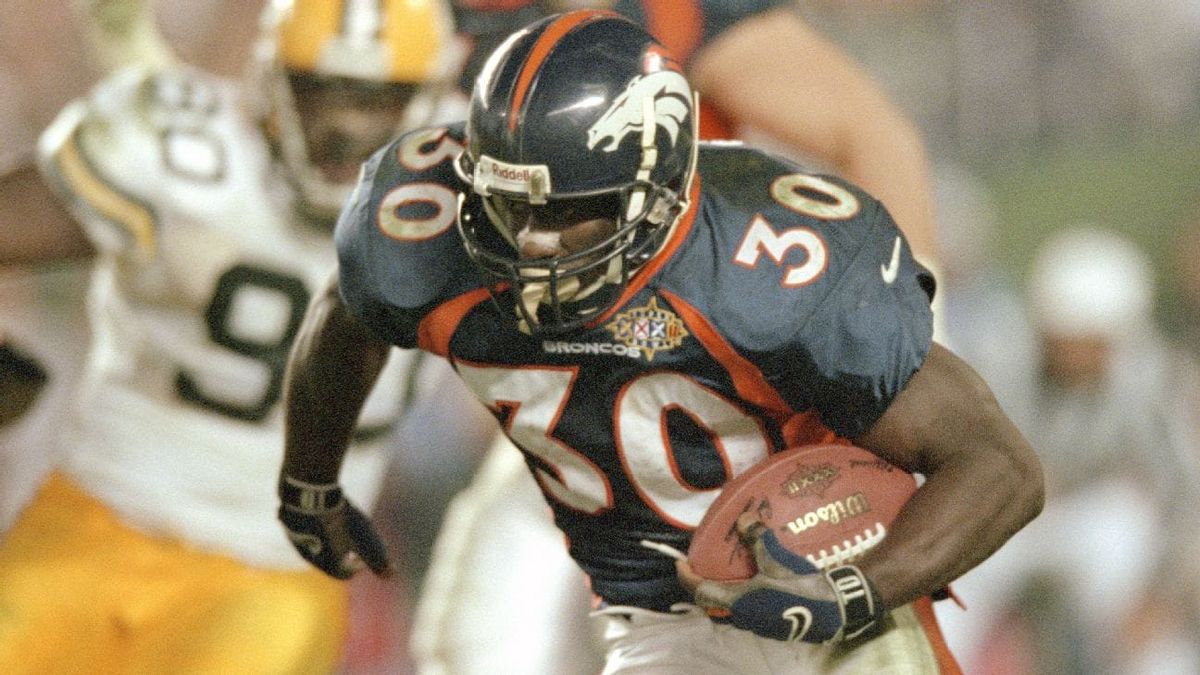
1. Terrell Davis (6th Round, 1995)
Some draft steals are impressive. Others redefine what a draft steal can be. Terrell Davis belongs firmly in the latter category, as a sixth-round pick who became the driving force behind Denver’s long-awaited Super Bowl breakthrough despite concerns about durability and modest college production, rushing for just 1,269 yards combined over his final two seasons.
Davis’ peak was nothing short of historic. He earned NFL Offensive Player of the Year honors twice and was named league MVP in 1998 after rushing for over 2,000 yards, becoming one of only nine players in NFL history to reach that milestone. At his best, Davis wasn’t just productive – he was unstoppable.
He rushed for 157 yards and three touchdowns in Super Bowl XXXII, earning the game’s MVP honors while leading the Broncos to their first championship in franchise history. Davis is also one of only seven players in NFL history to surpass 1,000 career postseason rushing yards, further cementing his legacy as one of the greatest big-game performers the sport has ever seen. The gap between where Davis was selected and what he became is almost impossible to overstate.